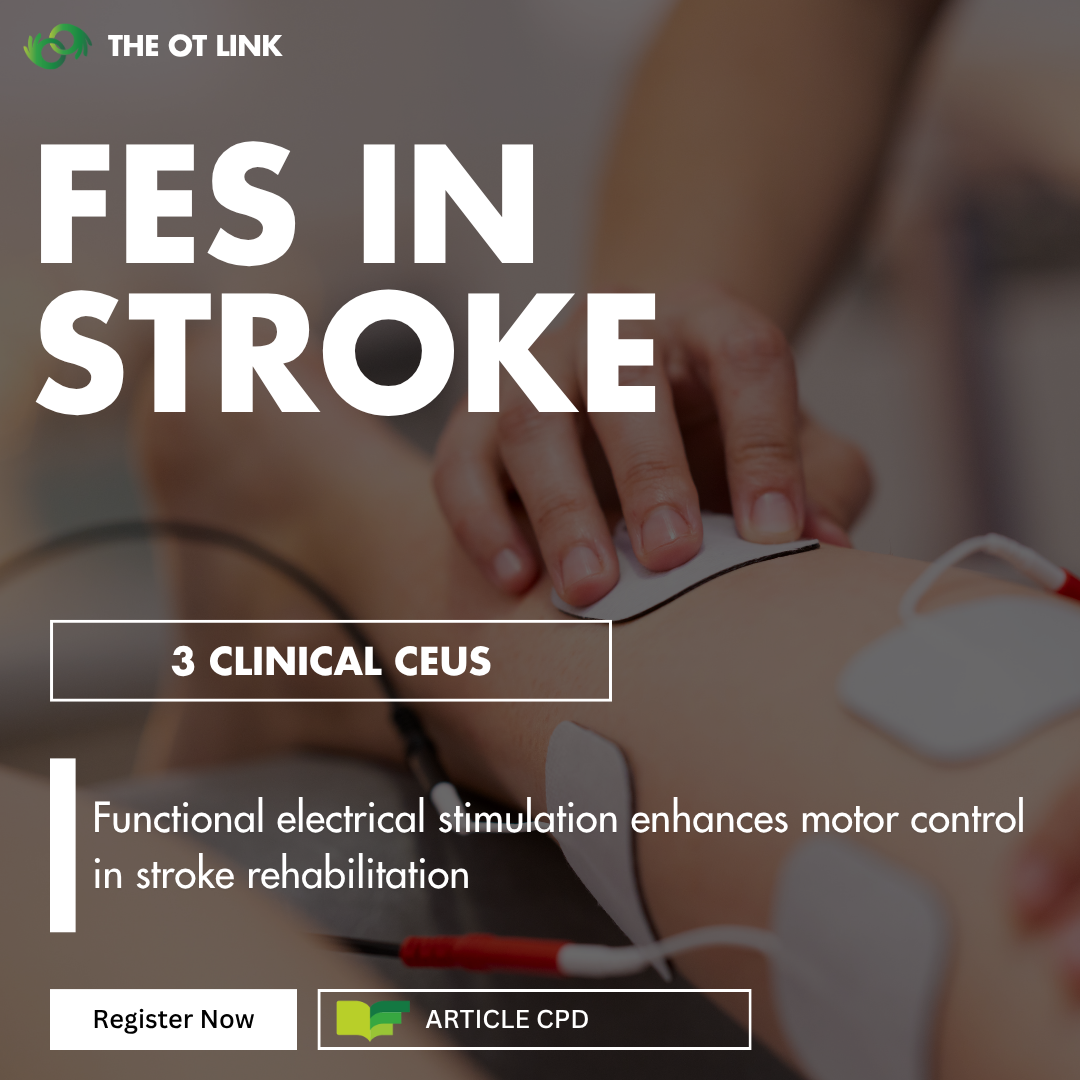
Functional Electrical Stimulation in Stroke Rehabilitation

Course Overview

2026 Content

3 CLINICAL CEUs.

Purchase access to the questionnaire on this open access journal article. You will be required to read the article and answer multiple choice questions related to the article (you must get 70% and above to qualify for the 3 CEUs).  

Objectives of this course:

On completion of this CPD activity, the participant will be able to:
  • Discuss the use of functional electrical stimulation (FES) in stroke rehabilitation.
  • Describe the use of F-wave and H-reflex measures to assess motor neuron excitability and spasticity following stroke.
  • Compare the effects of conventional rehabilitation and FES on functional outcomes (lower limb motor function, walking, balance, mental status, and activities of daily living) of patients with stroke.
  • Compare the effects of conventional rehabilitation and FES on the electrophysiological measures (F-wave latency and amplitude, and H-reflex changes) of patients with stroke.
 
* You have until 31st December 2026 to complete this task.
[wshk_display_notices]

R250.00

Description

Citation:

Liu Y, Fu W, Ren Y, Li H & Chen A. (2025). Functional electrical stimulation enhances motor control in stroke rehabilitation. Am J Transl Res. 17(5):3889-3897. doi: 10.62347/THME3127. PMID: 40535619; PMCID: PMC12170401.


Summary of the article

Functional electrical stimulation (FES), a form of neuromuscular electrical stimulation, is increasingly applied to improve upper limb motor function in stroke patients. While FES shows promise in enhancing motor function and reducing disability, evidence of its effects on motor control and underlying electrophysiological mechanisms remains limited. A better understanding of how FES interacts with stroke-affected neural pathways is essential to optimise protocols and develop more targeted, effective rehabilitation strategies. Therefore, this study aimed to investigate the effectiveness of FES in improving motor control in stroke survivors by examining electrophysiological measures (F-wave latency and amplitude, and H-reflex changes) alongside functional outcomes, including lower limb motor function, walking, balance, mental status, and activities of daily living.

Ratings and Reviews

3.3
Avg. Rating
3 Ratings
5
0
4
1
3
2
2
0
1
0
What's your experience? We'd love to know!
JENNY VERKERK
Posted 6 days ago
Functional electrical stumulation a useful method of treatment

It would be good to read about further studies in this field of treatment.

×
Preview Image
Anele Msimang
Posted 4 weeks ago
Good to know information for using FES clinically

More OT specific application would have been interesting

×
Preview Image
Asisipho Vimbani
Posted 4 weeks ago
Informative article

Essential information on management of stroke.

×
Preview Image
Show more reviews
What's your experience? We'd love to know!