Occupational Therapy in Forensic Solitary Confinement

Course Overview

2026 Content

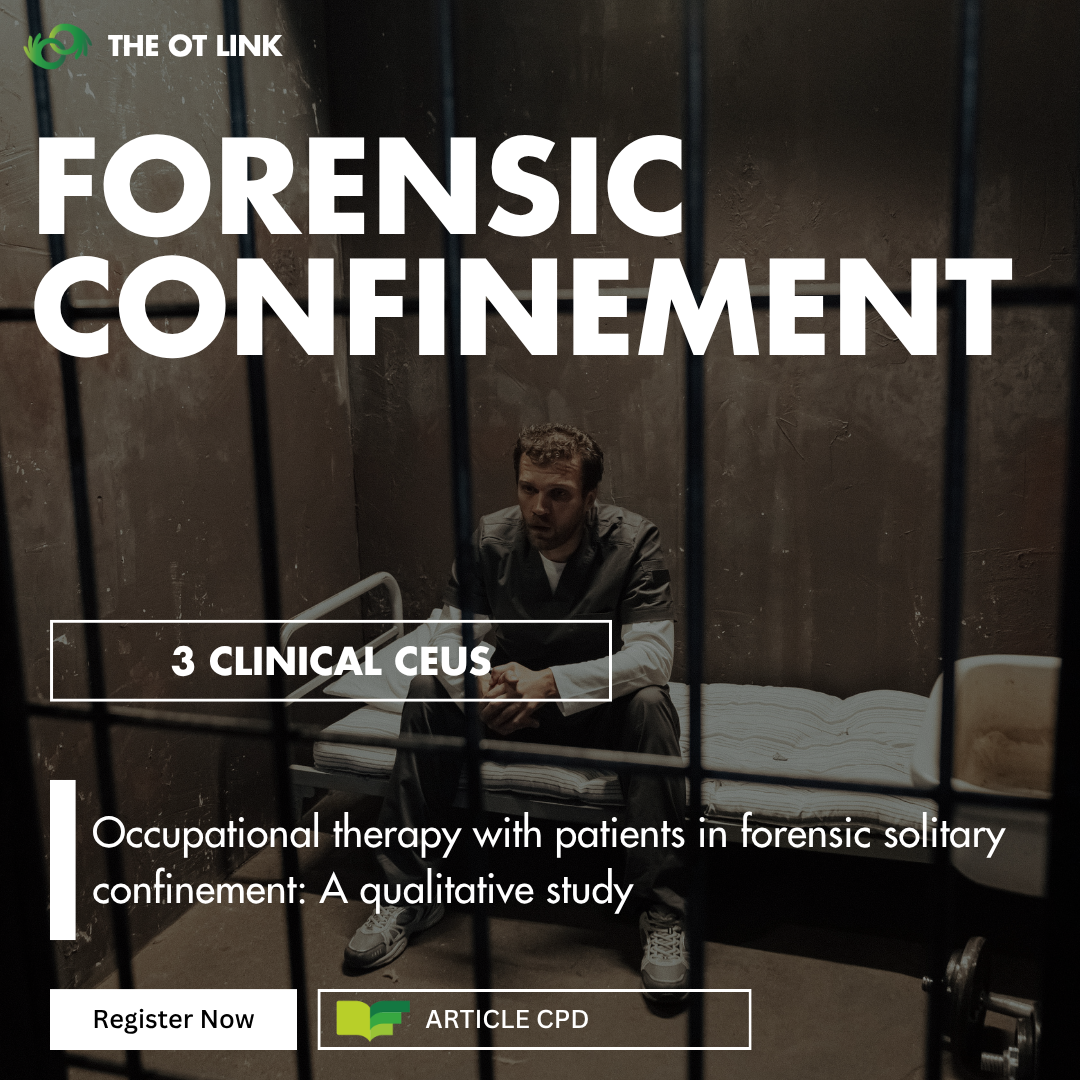
3 CLINICAL CEUs.

Purchase access to the questionnaire on this open access journal article. You will be required to read the article and answer multiple choice questions related to the article (you must get 70% and above to qualify for the 3 CEUs).  

Objectives of this course:

On completion of this CPD activity, the participant will be able to:
  • Describe the characteristics, purpose, and consequences of solitary confinement in prison and forensic mental health settings.
  • Explain the role of occupational therapy in addressing occupational deprivation and supporting well-being in solitary confinement settings.
  • Describe the work, context, and professional reasoning of occupational therapists working in solitary confinement settings.
  • Discuss occupational therapy approaches to the assessment and management of risk in solitary confinement settings.
  • Discuss how occupational therapists adapt interventions and facilitate engagement in occupation within highly restrictive and occupation-deprived forensic mental health environments.
 
* You have until 31st December 2026 to complete this task.
[wshk_display_notices]

Original price was: R250.00.Current price is: R200.00.

Description

Citation:

Mynard L, Joosten A, D’Souza A, Ashley D & Darzins S. (2024). Occupational therapy with patients in forensic solitary confinement: A qualitative study. Australian Occupational Therapy Journal. 71(4):447-460. https://doi.org/10.1111/1440-1630.12930.


Summary of the article

Occupational therapists play an important role in forensic solitary confinement settings, yet there is limited literature describing occupational therapy practice in this context. This study aimed to explore and describe the work, context, and professional reasoning of occupational therapists working in solitary confinement settings. Although focused on forensic solitary confinement, the study may provide broader insights applicable to occupational therapy practice in other restrictive psychiatric and forensic environments. Exploring how occupational therapists adapt interventions and facilitate occupational engagement in highly occupation-deprived and high-risk contexts may deepen understanding of the value of occupation, therapeutic risk management, and professional reasoning in complex mental health practice.


Ratings and Reviews

0.0
Avg. Rating
0 Ratings
5
0
4
0
3
0
2
0
1
0
What's your experience? We'd love to know!
No Reviews Found!
Show more reviews
What's your experience? We'd love to know!