
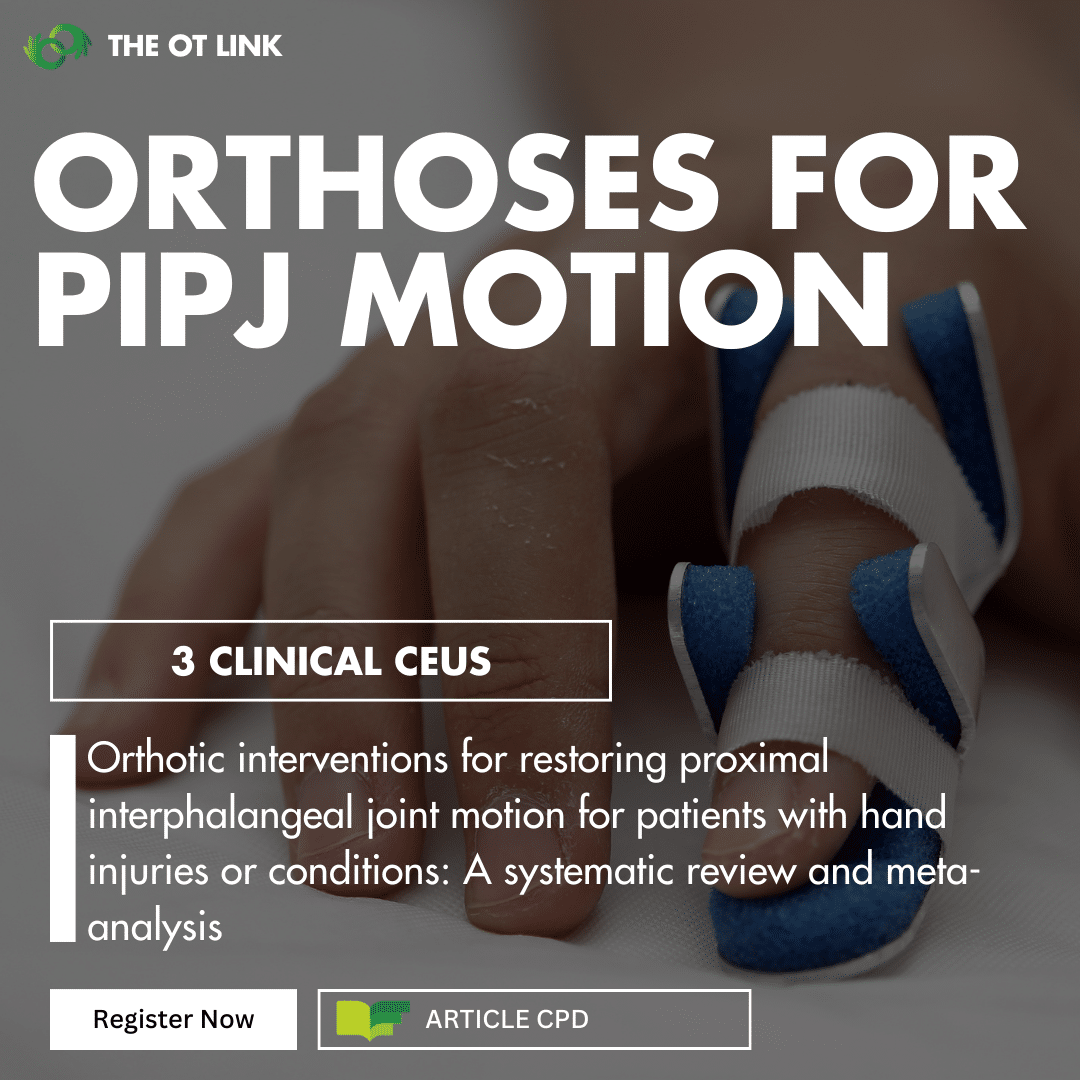
Orthotic Interventions for Restoring Proximal Interphalangeal Joint Motion

Course Overview

2026 Content

3 CLINICAL CEUs.

Purchase access to the questionnaire on this open access journal article. You will be required to read the article and answer multiple choice questions related to the article (you must get 70% and above to qualify for the 3 CEUs).  

Objectives of this course:

On completion of this CPD activity, the participant will be able to:
  • Describe the functional importance of proximal interphalangeal joint (PIPJ) mobility for hand function and activities of daily living.
  • Summarise the types of orthotic interventions used to improve PIPJ range of motion.
  • Critically appraise the evidence on the effectiveness of orthotic interventions for restoring PIPJ motion in individuals with Dupuytren’s disease or fixed flexion deformities.
  • Compare orthotic interventions with alternative or no interventions in terms of clinical outcomes.
 
* You have until 31st December 2026 to complete this task.
[wshk_display_notices]

R250.00

Description

Citation:

Yates SE, Glinsky JV, Hirth MJ & Fuller JT. (2024). Orthotic interventions for restoring proximal interphalangeal joint motion for patients with hand injuries or conditions: A systematic review and meta-analysis. Journal of Hand Therapy. 37(4):495-506. https://doi.org/10.1016/j.jht.2023.12.018.


Summary of the article

Limitations in proximal interphalangeal joint (PIPJ) motion can lead to significant functional impairment – adequate PIPJ mobility is essential for effective grasp and object manipulation, which underpin independence in activities of daily living. Although orthotic interventions are frequently used to improve PIPJ motion, there is a lack of high-quality systematic reviews and meta-analyses synthesising the evidence. This study aimed to evaluate the effectiveness of orthotic interventions in restoring PIPJ motion in individuals with conservatively or surgically managed hand injuries or conditions, compared with no intervention or alternative treatments. Understanding the strength of the evidence allows therapists to make informed, evidence-based clinical decisions, justify intervention choices, and optimise functional outcomes for clients with hand impairments.

Ratings and Reviews

0.0
Avg. Rating
0 Ratings
5
0
4
0
3
0
2
0
1
0
What's your experience? We'd love to know!
No Reviews Found!
Show more reviews
What's your experience? We'd love to know!