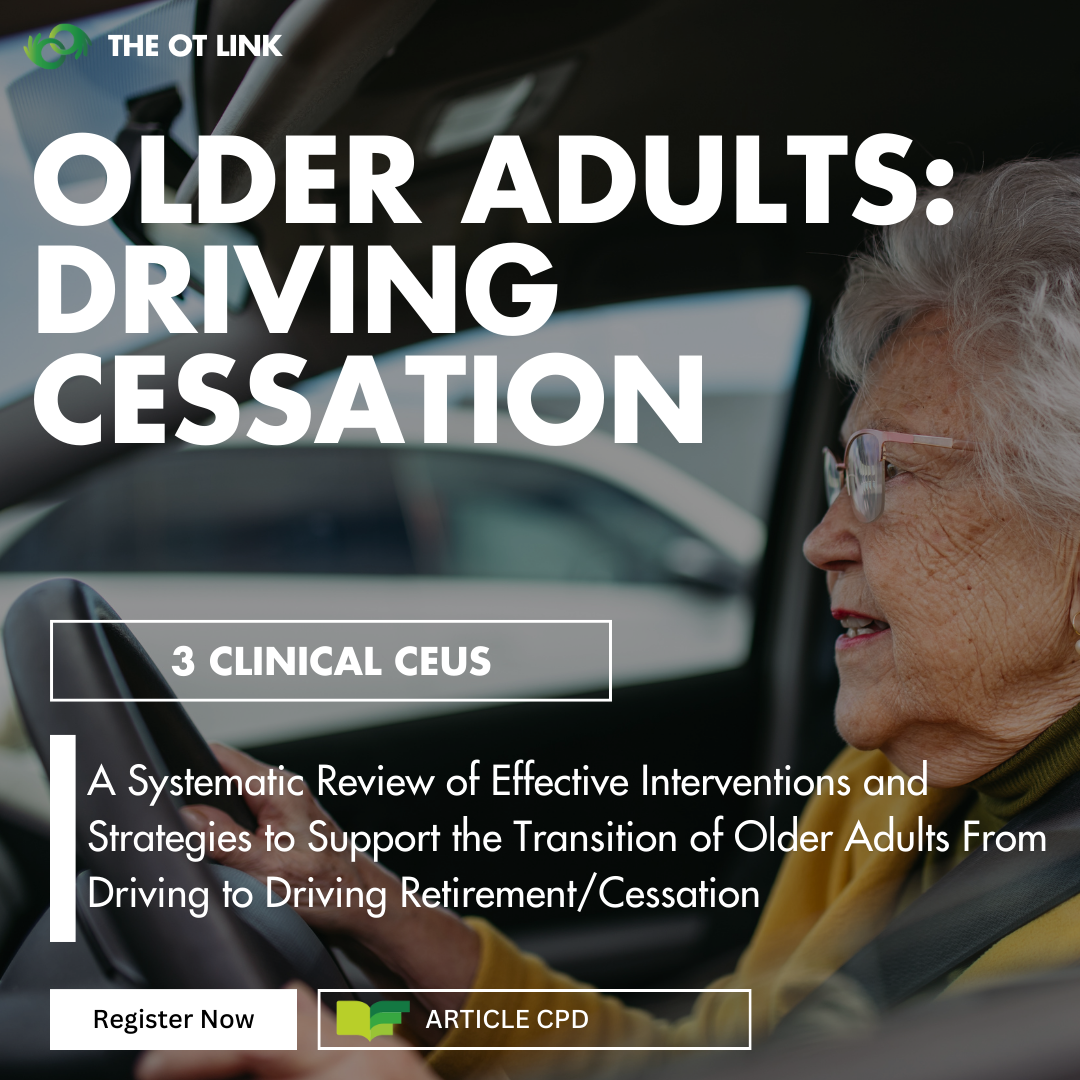
Supporting Older Adults’ Transition from Driving to Driving Cessation

Course Overview

2026 Content

3 CLINICAL CEUs.

Purchase access to the questionnaire on this open access journal article. You will be required to read the article and answer multiple choice questions related to the article (you must get 70% and above to qualify for the 3 CEUs).  

Objectives of this course:

On completion of this CPD activity, the participant will be able to:
  • Discuss how increasing life expectancy and high reliance on private motor vehicles influence transportation needs and mobility challenges among older adults.
  • Explain how driving cessation may affect social participation, mental health, and community engagement among older adults.
  • Identify barriers and facilitators that influence older adults’ transition from self-driving to driving cessation.
  • Describe the role of healthcare professionals, particularly occupational therapists, in assisting older adults to transition from self-driving to driving cessation.
  • Discuss interventions and strategies that enable healthcare professionals and others to support or facilitate driving cessation among older adults.
  • Describe structured driving cessation programs and toolkits for older adults reported in the research literature.
 
* You have until 31st December 2026 to complete this task.
[wshk_display_notices]

R250.00

Description

Citation:

Dickerson AE, Stapleton T, Bloss J, Géinas I, Harries P, Choi M, Margot-Cattin I, Mazer B, Patomella A, Swanepoel L, Van Niekerk L, Unsworth CA, & Vrkljan B. (2024). A Systematic Review of Effective Interventions and Strategies to Support the Transition of Older Adults From Driving to Driving Retirement/Cessation. Innovation in Aging. 8(6). https://doi.org/10.1093/geroni/igae054.


Summary of the article

Personal vehicles provide older adults with freedom and convenience for community mobility and social participation. However, increasing global life expectancy, a high reliance on private vehicles as the primary mode of transportation, and limited use of alternative transport raise concerns about how older adults will meet their out-of-home mobility needs when they can no longer drive. Older adults who reduce or stop driving are at greater risk of depressive symptoms, loneliness, and lower quality of life compared with those who continue to drive. It is therefore important to support continued community participation during and after the transition from driving to alternative transportation. This review aimed to examine current research on effective interventions and strategies to assist older adults in transitioning from self-driving to driving cessation.


Ratings and Reviews

0.0
Avg. Rating
0 Ratings
5
0
4
0
3
0
2
0
1
0
What's your experience? We'd love to know!
No Reviews Found!
Show more reviews
What's your experience? We'd love to know!